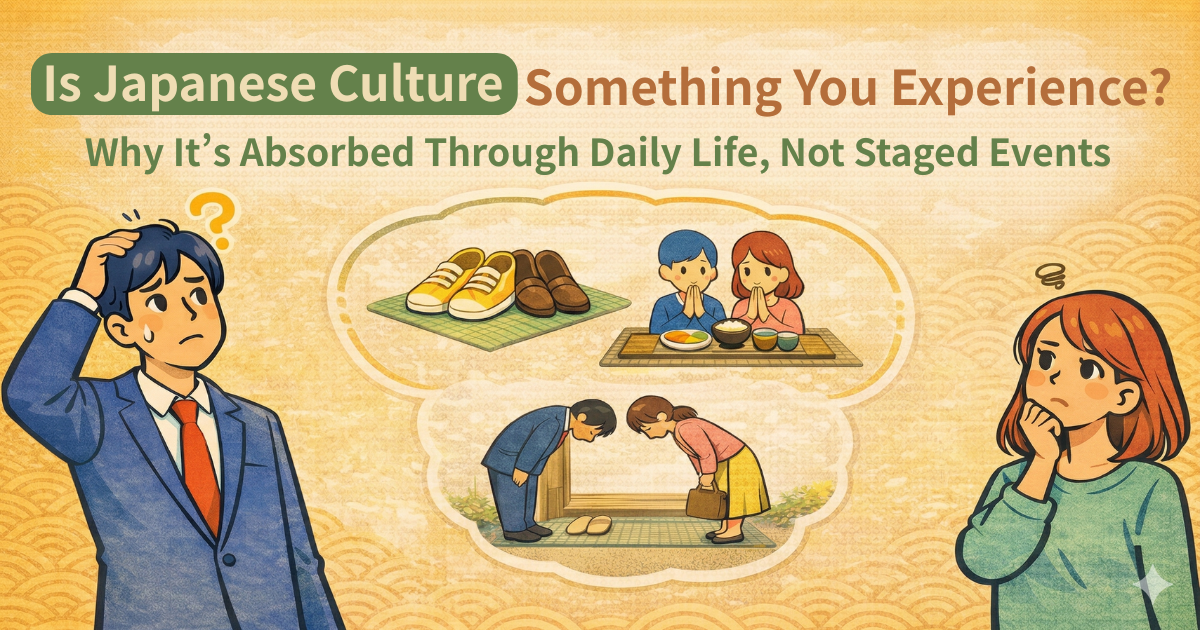
- The Hesitation Toward “Cultural Experiences”
- Culture in Japan Isn’t TaughtThe Aesthetics of Ishin-denshin
- Why Aren’t the Rules Explained?Respect Through Autonomy
- The Culture of “Ma” (The Space Between)The Essence of Japanese Nuance
- Culture Hidden in the MundaneThe Line Between Manners and Habits
- Reimagining Culture as an ExperienceResonance, Not Consumption
- YOLO DISCOVER’s ApproachStepping into Authentic Daily Life
- 【Q&A】FAQ on the Unwritten Rules of Japanese Culture
- Key Takeaways from This Article
The Hesitation Toward “Cultural Experiences”
“Let’s experience Japanese culture.”
When people hear these words, they often picture themselves wearing a vibrant kimono, whisking matcha in a serene tea room, or practicing calligraphy with a brush — the extraordinary moments of Japan.
While these are beautiful facets of a culture refined over centuries, those living in Japan soon realize that culture is something more subtle. It isn’t found on a tourist stage; it lingers in the grocery store line, the careful distance kept between diners in a quiet restaurant, and the “air” that flows between spoken words.
Japanese culture is less about what you study and more about what you absorb, like breathing. Let’s explore the true essence of this lived experience.
Culture in Japan Isn’t TaughtThe Aesthetics of Ishin-denshin
In Japan, you will rarely receive a manual for etiquette or cultural norms.
Learning Through Observation
Historically, skills and manners in Japan are passed down not through verbal instruction, but by observing the behavior of others and intuiting their intent.
Ishin-denshin (Heart-to-Heart Communication)
The virtue of understanding one another without words remains a vital part of daily life today.
Mastery Through Repetition
Rather than studying culture as an academic subject, people in Japan absorb it through repeated exposure. Over time, your body naturally moves in sync with those around you. This familiarity is the primary way culture is truly acquired here.
Why Aren’t the Rules Explained?Respect Through Autonomy
Living in Japan, you may encounter moments where you wish someone would just give you a clear answer on what is correct. Yet, even as you wait, no explicit rule is provided.
Trust, Not Neglect
Dictating rules to someone in detail can sometimes be seen as rude, as if you are doubting their judgment. Expecting someone to “understand without being told is, in fact, a form of profound respect.
The Politeness of Margin
Leaving “room” for the other person to feel, interpret, and decide their own actions is a core kindness in Japanese communication.
The Mismatch Signal
You might rarely be corrected directly. However, if you feel a slight sense of being out of sync with those around you, take it as a sign that you are touching the deeper layers of the culture. Observe that mismatch — it is your greatest teacher.
The Culture of “Ma” (The Space Between)The Essence of Japanese Nuance
One of the most essential yet elusive keywords in Japanese culture is Ma (Space/Interval).
The Richness of the Void
In Japanese art, music, and conversation, “empty space” is not “nothingness.” It is a space filled with unspoken emotions, time spent waiting for the other person, or an intentional pause to settle the atmosphere.
Conversational Pacing
A Japanese conversation is less like a game of catch and more like looking at the same scenery together. Don’t fear silence; enjoy the Ma. It is the first step toward comfortable communication in Japan.
Physical Proximity
Even in a crowded train, there is an invisible effort to maintain a “Ma” that prevents discomfort. This is culture in its most living, breathing form.
Take a step into the “air” of daily life.
Why not experience the unspoken “Ma” of Japan
within the authentic rhythm of the city?
>>Explore everyday cultural experiences
Culture Hidden in the MundaneThe Line Between Manners and Habits
Japanese culture doesn’t only exist in special places. Rather, the fragments of your mundane daily life act as the very cells that form the cultural body.
The Atmosphere of a Quiet Restaurant
Why does everyone lower their voice? It is a shared consciousness of keeping a “shared space” comfortable for all.
The Distance with Staff
Neither overly friendly nor cold. It is a sincerity found within a professional distance.
Orderly Queuing
People intuitively know who is first and who is next without exchanging a single word. When you begin to find these moments “interesting” or “comfortable,” you have already stepped halfway into Japanese culture.
Reimagining Culture as an ExperienceResonance, Not Consumption
At YOLO DISCOVER, we believe cultural experiences should be distinct from the usual tourist packages.
From “Learning” to “Being Present”
Instead of cramming knowledge, start by surrendering yourself to the atmosphere of a place.
The Struggle of “How to Behave”
The process of observing your surroundings and wondering “What is expected of me here?” is the deepest cultural experience of all.
Appreciating the Difference
The “surprise” or “discovery” that happens when your background meets Japanese customs is the very meaning of your life in Japan. Culture is not a show to be watched; it is a resonance felt from within.
YOLO DISCOVER’s ApproachStepping into Authentic Daily Life
We provide experiences that help you love Japan not as a stage, but as your home.
Unstyled Reality
We guide you to the seats where locals sit, not the chairs reserved for tourists.
The Frontlines of Daily Life
From real hair salons and neighborhood bars to local festivals, we open doors to the culture that lives right next door.
A Platform for Mutual Understanding
Your effort to feel the culture is a fresh discovery for the hosts, too. Taking that small step into the culture will turn your life in Japan into a lifelong treasure.
Step off the tourist stage and into the real Japan.
YOLO DISCOVER supports your journey
of becoming a true part of Japanese culture.
>>Sign up for free to find experiences
【Q&A】FAQ on the Unwritten Rules of Japanese Culture
Q: Why don’t Japanese people say “NO” clearly?
A: It is often a way to avoid making the other person “lose face” or to maintain the harmony of the room. Interpret vague expressions not as “rejection,” but as a form of consideration — a wish not to hurt you.
Q: Are there tips for “Reading the Air” (Kuuki wo yomu)?
A: Start with observation. Pay attention to people’s gazes, the tone of their voices, and their body language. By focusing on “patterns of action” rather than just words, the priorities of the space will become clear.
Q: Will I be disliked if I make a mistake with Japanese manners?
A: Not at all. Japanese people see the effort you are making to respect their culture. As long as you have a smile and a willingness to “do as the locals do,” people will support you warmly.
Find experiences that turn your life in Japan into a lifelong treasure. The gateway to culture is hidden right next to you. Sign up for free to see what discoveries await. There is no pressure to apply — only when it truly speaks to you.
>>Sign up to explore cultural experiences
Key Takeaways from This Article
- Shared Silence: Lowering your voice is a gesture of respect for others’ private time.
- Nuance in Hospitality: Free water and oshibori are rituals to help you reset and detach from the outside world.
- Reading the Room: Observe whether a café is for working or socializing, and respect the seating relay during busy hours.
- Gateway to Daily Life: Immersing yourself in a local, unstaged café is the fastest way to understand the rhythm of Japan.